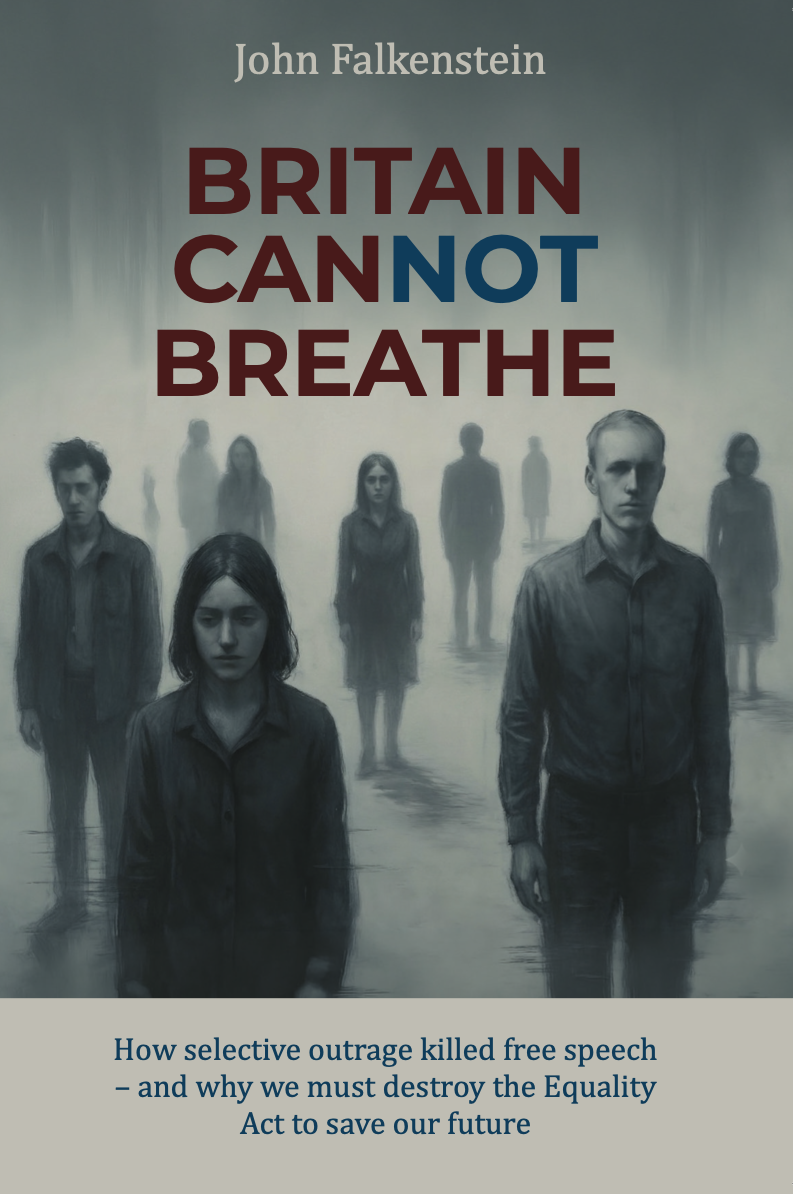
Now available on Amazon
Britain
Cannot
Breathe
How selective outrage killed free speech – and why we must destroy the Equality Act to save our future
Subscribe for fortnightly legal analysis, political commentary, book updates and exclusive extracts from Britain Cannot Breathe, by barrister John Falkenstein.
Advance praise
What readers are saying
“This is a remarkable book: clear, forceful, and important.”
Read the full review
John Falkenstein has taken a subject that is often discussed in abstractions or in whispers behind closed doors, and treated it with the seriousness it needs. He looks at the Equality Act not simply as a piece of legislation, but as something that has worked its way into the habits and assumptions of life. Its influence is now felt in the boardroom, in employment disputes, in public administration, in trade unions, and in the daily conduct of workplaces up and down the country.
What makes the book so compelling is that John does not leave the argument at the level of theory. He brings it to life through statute, cases, examples, and sharp observations about life. He shows how a law presented as benign, given a unassuming title and progressive notoriety has, in practice, produced burdens, distortions, and consequences that have gone insufficiently examined for too long.
John lays bare a central paradox: measures introduced in the name of fairness captured by ideology, become sources of confusion, resentment, and institutional paralysis as well as the all too familiar cash pile to those involved. The result is a system that hinders the very people and institutions it claims to help. It also shows how easily the language of legality can be used to produce outcomes that feel a long way from fairness.
John writes with the authority of a serious lawyer, but with clarity, wit, and independence of mind. He understands that law is never merely technical. It shapes behaviour, language, culture and political behaviour with the cause, effect and solution.
It is impossible not to admire the force of the argument, the range of the evidence, and the courage of the analysis.
This is a brilliant and intellectually compelling unsettling book such is the power of the scripture. It asks questions that many people have been too cautious to raise, and it offers pragmatic answers rather than simply complaints.
For anyone interested in law, politics, employment, public life, or the future of British institutions, it is essential reading. The most stimulating and enlightening books I have read in a long time.